Composer
John Lessard
A Conversation with Bruce Duffie
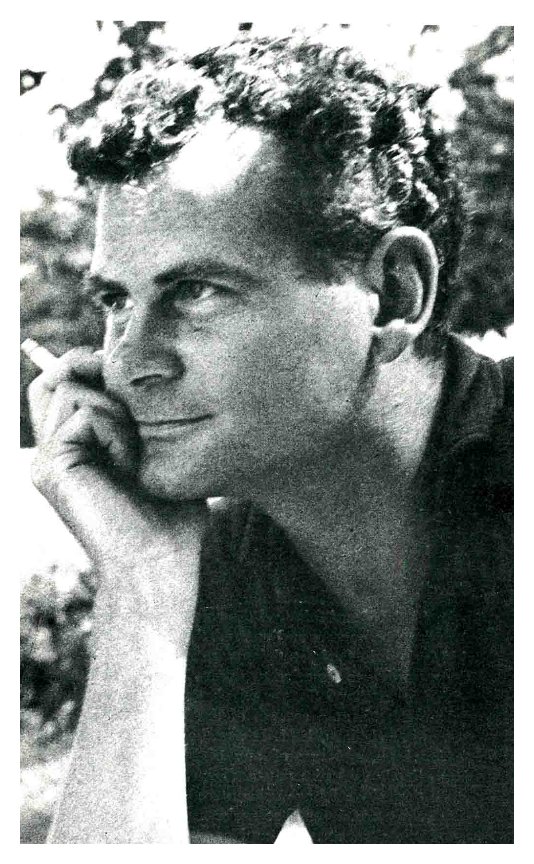
John Lessard is one of those composers who has an interesting background
with surprising details. Many of those are recounted in the interview
below, so rather than go through them now, I will let you find them in the
text. Needless to say, I was happy that he accepted my invitation for
a chat, and was very pleased to play his recordings several times on WNIB,
Classical 97. Note that names which are links on this webpage refer
to my interviews elsewhere on my website.
He was making a trip to Chicago in the spring of 1989 to visit a few
of his former students. During that encounter with the Windy City,
he set aside some time to come to my studio for a conversation. This
is what transpired . . . . .
Bruce Duffie:
You are both composer and teacher. How do you divide your time between
those two very demanding activities?
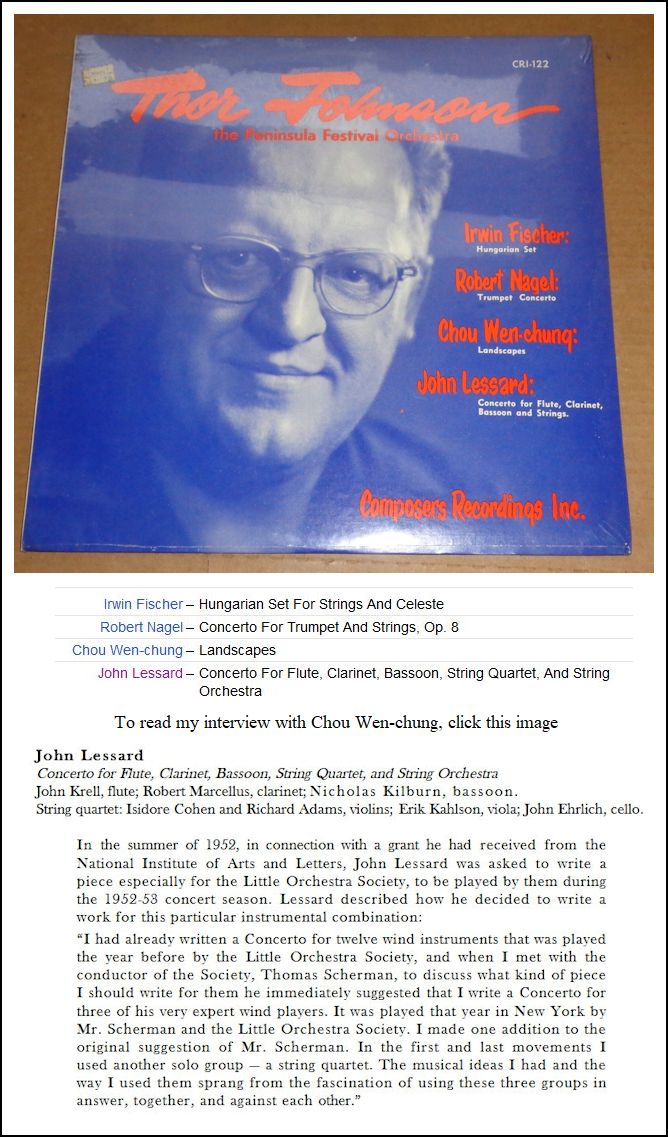
John Lessard: Well,
I’ve never had any trouble with that, and people have asked me about that.
Maybe it’s because I came to an official teaching position so late.
I was forty-two before I took a teaching job, which was the same place that
I am now, the State University of New York at Stony Brook. It was a
new university that was being formed there by the University of New York.
At that time, Governor Rockefeller was trying to raise its standards to compete
with the University of California and various other places, and make it
a dignified network of institutions, and he did raise them quite a bit.
This was a new institution which was just forming departments, and I got
in on the ground floor. It was just a great deal of fun to be in on
it.
BD: Was it
better to establish something, or would it have been easier to come into
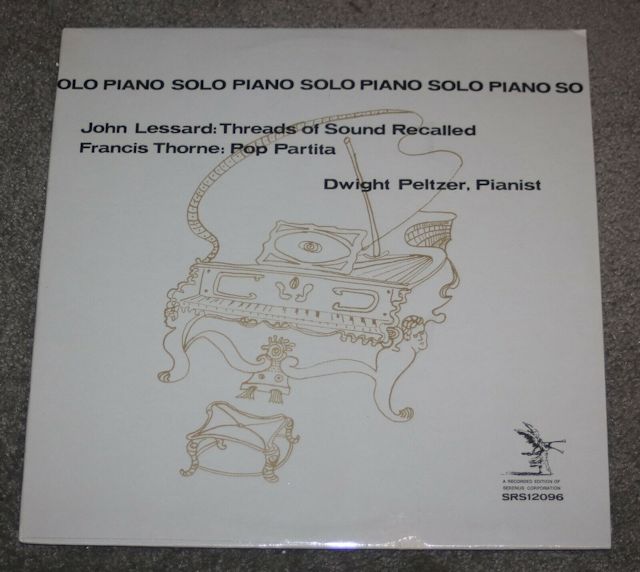
an established and running program? [Vis-à-vis the recording
shown at right, see my interview with Francis Thorne, whose work
is dedicated to Lukas Foss.]
JL: I don’t
know because I’ve never come into an established one. Up until that
time I had been just composing, working for foundations, teaching privately,
doing this, that, and the other. I had six children, so I was very
delighted to have a job! [Laughs]
BD: You’re
teaching theory and composition, or history and other areas?
JL: No, just
theory and composition. In our department we’re very specialized.
We have a very strong performance department — really
like a conservatory on the graduate level — and we
have theory and musicology separate, and composition separate. You
asked me how I manage composing and teaching. For me, composing becomes
a habit if you’ve done it all your life. By that time, it was just
like breathing. It was necessary for me. So it was something
which I had always incorporated into my life, and which had always been there,
and I just kept right on doing it, as the main part. As I’d been teaching
outside, or working for foundations, I just took it as another job which
I was doing on the side, and I found that it was working very well.
So I quit the other jobs, and went on with that. I find that I compose
just about as much in the summer times as in the winter times when I’m teaching.
I just go right along. Because so many people in universities just
quit composing once they get in, I always think that because I had been outside
of a university for so long before that, and hadn’t been attached to one...
[Sighs]
BD: You already
had established your roots and your patterns?
JL: That’s
right; that’s right. My pattern of life was there, so it’s never been
a difficulty. Right now I’m looking for things to do, because as you
know, I’ll be seventy and I’ll have to retire.
BD: The University
says you must go?
JL: Yeah, that’s
right. I think it became a federal law; it was one of the few things
that was left — tenured professors must retire at seventy.
But I’m glad to retire, and to change. I think it’s good for the institution,
and good for me as well.
BD: You started
teaching in 1962. How have the students changed from the early- and
mid-sixties, to those you’re encountering now in the late eighties?
JL: I would
say that they have changed a great deal. The first four or five years,
when the department was building, we didn’t really have a graduate program,
so I won’t count those. But once the graduate program did start, we
had some very famous names in our department, especially in performance.
Those are the kind of people they get, who are in the public eye the most,
which drew attention to the Music Department immediately. Those names
also drew good students. Then on the graduate level, I would say that
it stayed pretty much the same, although the composers coming in to study
composition always have different ideas of what they want to do. As
you know now, in the sixties it was mostly serial technique. You would
open the door, and it wouldn’t make any difference whether they were coming
from Indiana, Paris, or San Francisco. Their work looked about the
same at that time. Now there’s a very conservative trend, but I would
say that the level is about the same on the graduate level, just because
of the reputation of the department. The undergraduate, of which we
haven’t really established a thing, has changed a lot. I think that
our students were much better in the seventies than they are now.
BD: They were
more interested?
JL: There was
more interest, yes. Enrollment has been going down, and the level
of the undergraduate has been going down, too. It is not really building,
and that seems to be a problem — at least it seems
to be for us, and I’ve heard that other schools are having that problem, too.
BD: Is musical
composition something that can be taught?
JL: No, I’ve
never thought so, and my training, which is mostly French, assumed that
you couldn’t. You just taught technique and left it to the person
to compose; then it was really up to them. But in America, the teaching
of composition has been established, and I think in a way I’ve come to believe
it’s good. I still believe that the technical things are the surest
to teach. Composition is a very nebulous thing to be teaching.
Where one helps the most is if one is like a backboard for the young composer,
instead of him being in a complete vacuum, just writing for nobody out there.
He can come at a regular interval, show his things, have a reaction, and maybe
be told, “Show it to somebody else. Show it to this person.” I
think that it’s a very personal thing, too. Some people work very well
with you, and some don’t, so I’ve always put it that way to my students.
“We’ll just see whether this works or not; see if it works for you.”
BD: You say
you want to show it to various people. At what point do you say, “Get
it performed”?
JL: I say it
right away if we can get it performed — no matter how primitive it is, just
so that they hear it and get the experience of sitting in a hall hearing
it. I’ve worked on the performance side very much within the department.
Next week I’ve got seven compositions going to be played, coming out of
a class just this semester. Some of them are pretty good! They’ll
be there and they’ll be well performed by a student group.
BD: Are there
ever any little ideas that you hear in the students’ works that you then
incorporate in your own music?
JL: No, I wouldn’t
say there’s ever been an idea, but every five or six
years there seems to be a change in attitude, a change of the way they want
to do things. It is very challenging for one to adjust to it and try
to understand, but that kind of exchange is very helpful! But
no, I don’t think I ever have really copied anything, although I would like
to! I think stealing is the best thing! It’s the easiest and
the best thing to do, but I can’t remember doing that!
BD: Nothing
even subconsciously?
JL: Nothing
came up that would work for me, and I couldn’t get it in there! Although
I’ve often told my students, “I’d just love it if you’d do something I could
steal!” But generally it’s an attitude which has changed my attitude
slightly and made me look at things in different way.
BD: So it has
influenced you?
JL: Oh, yes!
Oh, definitely! Every new movement that comes along influences you
somehow. You’ve got to react to it.
BD: But you’re
not someone who jumps on every bandwagon.
JL: No!
Oh, no, not at all. In fact, I’ve been very slow at that kind of a
thing. I’ve kept my own track, I’d say, very much. But I’ve evolved
continually. I’ve never been on a popular bandwagon.
BD: You’ve
forged your own way?
JL: Well, yes.
I’m not an idea man. I’m not a man that says, “Oh, well, let’s try
this, and see if we can do music this way.” I don’t get any fun writing
music; it doesn’t work for me. Composing is intuitive, and to be intuitive
you’ve got to get into a style and into the material, and that takes time.
You can’t be intuitive if you’re using absolutely completely experimental
materials or something that’s way out there.
* *
* * *
BD: If your
compositional process is intuitive, when you’re writing, how much is the
pencil controlling you, and how much are you controlling that pencil as it
goes along the page?
JL: Of course
it’s never an exact percentage one way or the other. I don’t know
what you mean, exactly, by “pencil.”
There can be several things that are in the pencil besides just the musical
notation itself. What else did you mean, besides the notation?
BD: In this
case, are you always controlling what goes onto that page, or are you just
a conduit for something that’s in the atmosphere?
JL: That
pencil on the page just comes down to musical notation. I tell my
students right away that when one has an idea, it’s an image which is out
there, a beautiful image which is before one. Then one strives to
get that sound that one is after, that sound with a certain movement,
with a certain rhythm. It’s something that one wants to capture.
I always tell them — and of course I tell myself when
I start — I’m very cautious to put notes down on paper,
because as soon as you put something on paper, that freezes it in that shape.
Before you put it down, you’re flexible; you can move in any direction.
So I often don’t put the whole thing down. I’ll just put the vaguest
indication. I’ll put just a few notes with no rhythm whatsoever, just
the general direction. Later I will add a few notes next to them and
just indicate them, spatially, on the page so as to leave them. Let
it be as vague as possible. The order of the notes I sometimes will
leave, but the order can be changed — in this order,
in that order. I leave everything as nebulous as possible, so as not
to have it frozen completely — which is what notation
does to it. It’s frozen; it’s there. A portion of that dream,
then, is lost, once it’s frozen. But you’ve got to do it sometime,
or you have nothing!
BD: Or you’re
John Cage.
JL: Yeah!
[Both laugh] Yeah, that’s right. It would be that, which is another
kind of profession!
BD: Now you’re
approaching your seventieth birthday and you’ve been writing music for nearly
half a century. How has your music changed and developed over all that
time?
JL: Of course,
like anybody, it’s been circumstances and what was going on in the world
which has influenced it enormously. It’s certainly my time that it influenced
it, and it’s a very particular time, my time. All of my musical education
was before World War Two. Although after that I never went back to
school again, I would say my schooling has gone on continually! [Laughs]
But most of it was before then, which makes a difference, because what was
going on in the world before World War Two and after World War Two, was
very, very different, and the fact that all of my school influences were
before is very significant. I started in California, in San Francisco.
I was in Palo Alto most of the time until I was sixteen, and amazingly enough,
Schoenberg’s music was available to me because that was being done at Stanford
by the Kolisch Quartet; he was his brother-in-law, of course. So the
quartets of Schoenberg were there and as a young man I knew that they existed;
they were very much there. As a young man I had a scholarship to study
with Schoenberg, but I had such a repulsion for his music and for that outlook
on music, that I refused the scholarship and I went to France. That
was where I was aiming to go from the beginning, coming from a French family
and having had a background and training from people who had been studying
in France, especially at the École Normale, where I went. So
I went at sixteen to France, and there the Viennese School was not even heard
of! Nobody had even heard of it. As Boulez said, he was the
one that after the war had to play, for the first time, Schoenberg and Webern.
There, the Neoclassic School was successful; it was the all-successful thing!
Actually, in some ways it was more advanced sitting in little Palo Alto than
it was in Paris or in any other European city at that time, because they
were just confined to Vienna. So my influence there was definitely very,
very much of the Neoclassic School, and especially of Stravinsky. I
knew Stravinsky was around. I was there with him, and all of that school
influenced me very much. So I wrote some very individual pieces at
the beginning, and then they took a more and more Neoclassic cast.
BD: What specifically
did Nadia Boulanger give to you in terms of advice or encouragement?
JL: I met her
when she was maybe slightly past the prime in her teaching, but near her
prime, and I knew her right to the end of her life. She was my Godmother,
so I was very close to her. I would say that what she gave me was just
what she wanted to give me, which was technique. We just studied harmony,
counterpoint, orchestration, things like that, at the end of the lesson.
I wasn’t one of these American college graduates that she had
to treat as a grown-up, or an adult. I was sixteen and young
enough so that she didn’t have to. She would slap me down, and then
at the end she’s say, “Have you written something?” I’d say yes, and
she’d look at it and say, “Oh, fine, very good. Why don’t you look
at somebody else’s work?” but wouldn’t say too much about it. One day,
when I was about eighteen, she just said, “I think you are a composer.”
That’s all. Just out of that! I went on
from then!
BD: You had
arrived!
JL: Well, she
saw something, and thought, “I guess this fellow is
going to compose.” I went on still with my technical
studies and she gave more and more comments. She also started playing
my music in little concerts here and there, and arranging things. That’s
how it went. Her main influence, I would say, was a technical one,
and a joy of looking at music — which she still had
at that time — an enormous joy of looking at music!
Then I had the whole war away from music. I stayed in France until
Paris was taken by Germans. I got out and got to this country, and was
drafted and went back and was attached to the French Army for the whole
war.
BD: Because
of your knowledge of the French people and the language?
JL: Right.
I was put in a small unit for liaison between American and French, next to
American troops and the French troops — the idea being
that they wouldn’t shoot one another. [Both laugh] I passed the
whole war like that, which was a different thing if you were born at that
time. Then there was that emptiness which came in after my training.
When I came back, I’d already had one child. I just got to work composing,
and my influence then was very much in this country. I was on the east
coast, near New York on Long Island. Aaron Copland had known me from
before the war, so he met me in New York, because he had been a student
of Nadia Boulanger also. I had one year before I was drafted.
I went to Boston and Nadia Boulanger, for some reason, appeared in Boston,
too. I went to Boston because Walter Piston was there, and I knew he
was a student of Nadia’s. So I went there, but I sent a piano sonata
to Aaron Copland. He immediately got it played by Johanna Harris at
the League of Composers. Virgil Thomson gave it an excellent review,
so then I was right in with her old bunch — Walter Piston,
Virgil Thomson and Aaron.
They knew me from that. Then I was drafted and went to war.
When I came back, I was known a little bit here by that group. They
very much supported me and helped me because I had been gone those years in
the war. So I had my start, and all of that period, up until about 1960,
I wrote neoclassic music. The music of Schoenberg I still didn’t like,
except the early works up through Opus Nineteen, before he turned it into
a system. German Expressionism, even in painting, I’ve just not liked!
It’s been something that I don’t get!
BD: Do you
respect it?
JL: I respect
it from a distance, but I can’t digest it. It repulses me. I
have kind of a feeling against it. I can’t digest it. Even great
composers, too. I respect Wagner, but I can’t stand his music.
I try often, even!
BD: Do you
feel that you are part of a specific lineage of certain composers?
JL: Oh, yes,
sure; Stravinsky and Debussy, certainly. I would be able to say definite
people have influenced my music. When I was young, I loved very much
the music of Bach and of course Mozart, Beethoven. Chopin, I always
adored; Monteverdi and all of the early composers; Josquin I adored.
Maybe the earlier works had more influence on my works than that, but a definite
influence after Stravinsky was Webern when I got to know it. I hadn’t
known any of his music, and I began to know it around ’55, ’56, ’57.
I began to know a little of it when a few pieces came out here.
BD: So none
of the other French composers such as Massenet or Charptentier?
JL: No, no,
not at all! Of Fauré I liked certain works; Debussy, but no,
not Massenet or Berlioz. Sometimes Nadia would think, “Well, you’re
young. Buy the Symphonie Fantastique
of Berlioz.” I’ve come to like Berlioz more now, but at that age he
wasn’t pure enough for me. I wanted things even more pure than Berlioz.
But then Webern started to be an influence. Even neoclassic music
is different; everybody does it differently. But Webern began to influence
me in ’57. That technique took a long time. I had to listen to
lots and lots of works before I could really understand what was going on
musically. But I was fascinated, and I kept on! All of a sudden,
I just turned; switched and tried, and the amazing thing is that when I look
back now, I can see that it just wasn’t as difficult a switch as I thought
because structurally there isn’t that much difference between the neoclassic
and the serial. But of course, one could always see that I was never,
never a strict serial composer, a strict twelve-tone composer. I have
my own way of dealing with it.
* *
* * *
BD: Let me
ask the big philosophical question — what is the purpose
of music in society?
JL: Oh yes,
that’s a big question, and of course it’s a very personal thing, and it depends
on the time that one lives. But what I think of especially when I’m
posed that question, I answer with a line in a poem of Auden, in which he
says — more or less, I’m not saying the exact words
— but the eleventh commandment is “Thou shalt not sociologize!” [Both
laugh] Lord only knows where it’s been in society, or what it does,
but for me as a person, it has been a great joy all my life, and a beautiful
thing. It is something which has been able to take me out of myself,
and it’s never failed me yet. It is just like a beautiful building,
like Chartres, or a painting that is beautiful. One forgets one’s self,
and one lives with that beautiful object. Because of that, in some
ways I hope that there may be a slight bit of that truth which is a little
opening to the whole mystery of whatever this is — our
wonderful life on this planet for the little short time that we do have here!
I don’t mean to make it something sacred, but for me it does have that delight
and that beauty. I don’t know what it does for society, really.
I think that for those of us who love it, it does do that. It helps
us with a beautiful thing, as any beautiful object will help us through
this life and others.
BD: When the
audience comes to hear a new piece of yours, what do you expect of that
audience that’s sitting there listening to your music — if
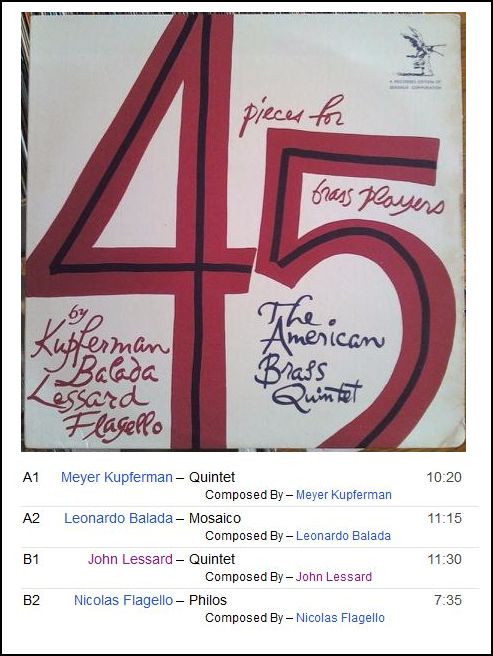
anything at all? [Vis-à-vis the recording shown at right,
see my interviews with Meyer Kupferman, and
Leonardo Balada.]
JL: I don’t
expect anything at all. It depends upon which audience it is; you expect
different things. The audience during my musical time has been mostly
fellow composers. The audience has not been that disparate. The
music of my time has been so disconnected from society.
BD: But you
don’t write just for other composers, do you?
JL: No, no,
I don’t write really for other composers. I write for myself!
I write what I hear. I don’t write down for an audience, or I don’t
try to hit an audience when I’m writing. I just exist with the music.
I don’t try to do it less well for an audience. I do what I think is
just the very best way of doing it, the most fascinating and the most beautiful.
I just hope that there are other people that’ll find it the same.
One has to hope that one is close enough to one’s fellow beings that there
may be some out there who will react to it in the same way. But of
course I’m very influenced by adverse criticism. I’m influenced when
somebody loves the piece or when somebody likes it. Of course, I adore
that! Even when critics, as silly as they are, say something nice
to you, you do like it. But they will say it about one piece, and
then ten years later that same piece will be played, and the critics, or
an audience, will say it’s horrible! [Both laugh] So you don’t
know where you are, or where one really is looking for the absolute truth
in this.
BD: Have you
basically been pleased with the performances you’ve heard of your music
over the years?
JL: No!
No, very seldom! More and more, I am pleased even less!
BD: Really???
JL: When they’re
done by professionals, I find I am less and less pleased with the performances.
But I am more and more pleased when I can do it with students.
BD: Are they
more flexible?
JL: No, they
spend more time on it! Everything has become money, in America.
Just straight money! To do what we do — contemporary
music — it doesn’t pay very much when you walk in
to do the job. This is true even with the ones who are known as the
greatest specialists in contemporary music with big reputations! No
matter what they do, they sit and read the piece. They can do eleven
against seven, three against fifty-two, anything you want! They do
it and they walk out, and they don’t even know what the piece is! They’ve
done it beautifully, as it is written there, but no piece of music has been
communicated. When I can work with students, we can go until they
do it musically; the way you would learn a piece if you were a pianist learning
a Beethoven Sonata. I have a group, and we can sit for three months
and work on the piece, day by day, and they get to learn it. They
get to know it and then they can get to like it. When they walk out,
they project a piece of music with meaning, instead of just an accurate set
of notes. So that’s what I miss very much, because of the pay situation.
I do point the finger very much at the American scene for that, very, very
much. I have a daughter in Paris who’s in the dance (and two grandchildren
there), and I have daughters who are here who are in music. The difference
between the careers of those two people is just incredible! My daughter
in the dance there, her husband has a ballet company — a dance company which
is subsidized by the government. When they speak about art and their
dance, this is only what is the most beautiful for the dance and what they’re
going to do. One hundred percent of the time, that’s what they’re doing!
They make a huge effort to do it, but the government subsidizes them.
Here in America, they’re jobbing ninety percent of the time, and the other
ten percent of the time they get to play a piece which they want.
BD: But the
situation in France is where we’ve just had this whole big blow up at the
Bastille Opera, with some of the politicians trying to take control, and everything!
Isn’t that the backside, then, of the subsidy?
JL: [Laughs]
Yes, it is! It is the backside in all of those subsidized countries,
but less in France. In the really subsidized countries, like Holland
and I think some of the Scandinavian countries, and for a while in Italy,
too, it was like a hothouse; they felt anonymous because everybody was subsidized.
You would get a title of genius or near-genius or mediocre, but it would
be passed out and there was no real judgment being done. I do think
that the situation is better. But I’m complaining because I’m here;
I’m an American and I’d like my own situation to be better! But there
are wonderful people in it, and I’m very interested in performance of new
music. I’m getting more and more involved in it, and when I retire
I think that that’s what I’m going to try to push, as much as I can.
BD: Are
you optimistic about the whole musical scene?
JL: No,
but I like making good performances, and they please me when I can bring
them off! I won’t brag too much, but I will say that at on the performance
side at Stony Brook, we have really among the top players in New York for
most of the instruments. We have pianists Charles Rosen and Gilbert Kalish. Since
the beginning we’ve had flutist Samuel Baron, and we had
cellist Bernard Greenhouse who just retired. So we get excellent
students. They’re just top students, and they’re idealistic, too.
Even though they know there’s no place to go, they’re there because they
love music and they’re doing their instruments. We’ve been putting on
a concert in Merkin Hall once every year with six premieres.
BD: New works
by faculty?
JL: No, no!
No faculty at all! Nothing to do with Stony Brook; everything outside
of Stony Brook. I want this to be a thing for composers in general,
from San Francisco to New York, and chosen by people outside of the university.
Once the works are chosen, we have to say what will work, what we’ve got
instruments for, but we choose from the works that they have suggested.
BD: Are you
helping to do the choosing?
JL: Yes, along
with Gilbert Kalish and percussionist Raymond DesRoches.
BD: What advice
do you have for the young composers coming along?
JL: If they
can, to marry a girl that works in a bank. [Both laugh] That’s
about it. I tell them pretty much what the situation is out there,
and to really love what they’re doing and do what they can. The situation
right now is very, very poor to expect to get a job in a university.
There just aren’t that many jobs for composers now. Where the jobs are
beginning to appear, the composers will need to have a little bit of knowledge
of electronic music and computers. If they can get a little computer
job, it seems to be more the thing that they should try to aim at if they’re
going to subsidize themselves somehow.
BD: Are we
perhaps turning out too many young composers?
JL: I would
say so. It’s a question of every department wanting to turn out composers,
and turning out an awful lot of composers that aren’t really composers.
Some go into other departments and then they immediately stop composing.
So that scene has changed very much since those first days when I hit New
York and there was just Virgil Thomson and Aaron Copland. As Virgil
said, there were only about six people in America who could orchestrate anything
decently to even be played on the radio for the background music! Everybody
knew who everybody else was. Now it’s five or six hundred per square
mile, it seems! [Both laugh] I think maybe we have trained too
many. It all started with Roger Sessions — and I don’t blame Roger
for what he did — when he entered into Princeton. He was the first
one who got into a university department. It was just the time when
people were beginning to think that the traditional studies of harmony, counterpoint
and so forth, were not relevant. He wrote harmony books, and he taught
harmony and so forth, but the idea was that one was going to teach composition.
So this became more and more the dominant thing, whereas now the standard
techniques aren’t as relevant! Let’s face it, the traditional harmony
and counterpoint isn’t as relevant as it was to Gabriel Fauré!
But those first composers were teaching those techniques to everybody
— to the performers, to the musicologists, to everybody.
There was a reason for them to teach harmony, counterpoint, things like
this, and now they won’t hire a composer for that.
BD: Isn’t there
a reason, though, that every composer should know those techniques just to
have that in their background?
JL: That’s
hard to say. Of course, I believe that it is helpful. Some of
my younger composers have learned it and do know it well, and a lot of them
haven’t because it isn’t really required that much in any program that I
know. But those who do know it really well say that they can notice
it in other composers from Europe and here, and they can tell the difference
of those who are well-trained and those who aren’t in the conventional techniques.
At the same time that I say that, I know that it certainly isn’t as relevant
as it was a hundred years ago or even seventy-five years ago. It really
isn’t. Maybe there should be other techniques which can become more
useful, sort of like techniques at the barre for the dance — just
pure, technical things. Maybe there should be some technical exercises
around the serial technique or around various other things, working with
timbre or things like that. But the styles never solidified enough
to make those exercises really necessary. We’re in a period of flux,
and we have a lot of marvelous young composers coming along in spite of the
too many numbers! There are a lot of them who do come in, and then
in the end it is always a mystery when one writes a beautiful piece of music.
It isn’t just because they have technique, you know. One can’t put
it all on technique.
* *
* * *
BD: May we
talk about your recordings?
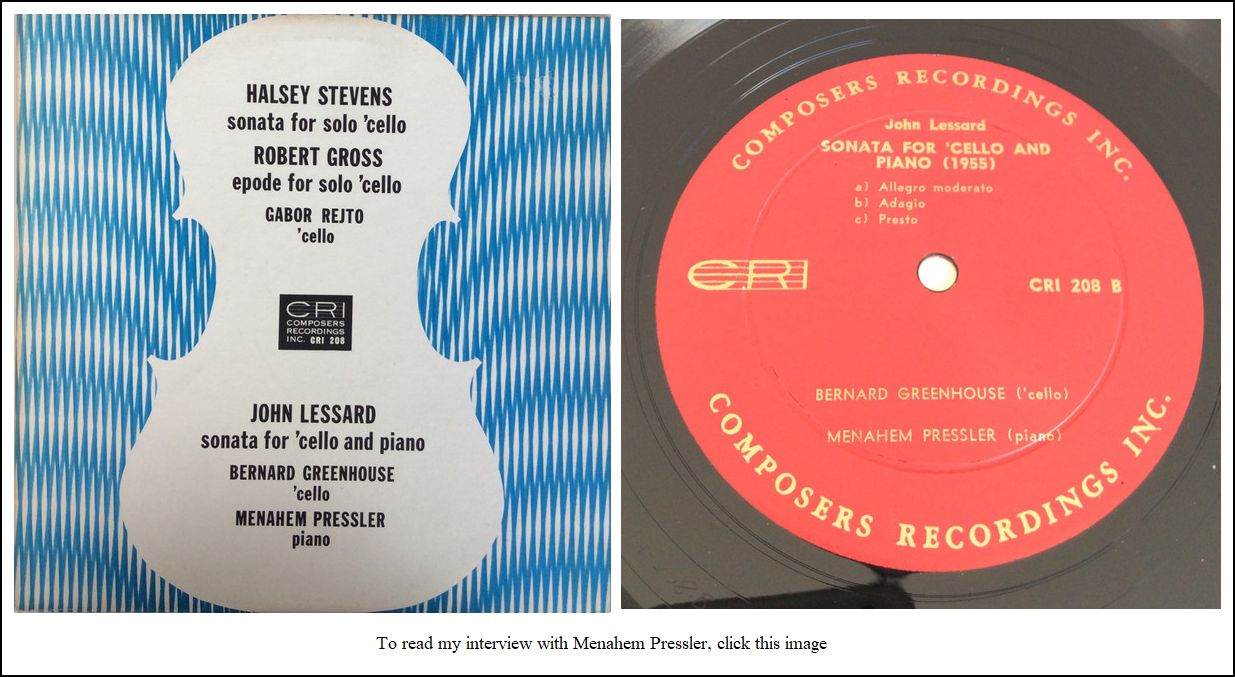
JL: I see that
you have my records there and you were thinking of them. That one on
top has the Concerto for Winds and Strings
and the Sonata for Cello with Bernard
Greenhouse. Those are on C.R.I. I had those two come out very
early on C.R.I. They are excellent recordings and represent my works
very well. Then I got on the board of C.R.I. and worked on it for
twenty-five years. I decided I shouldn’t have any on C.R.I., because
I was working on the board! Then I had a publisher, a marvelous man
— Paul Kapp — who put out Serenus Records. I
must say that the technical side is not that good. There’s a lot of
print through on some of them, and it is noticeable even more now.
BD: But the
performances are all right?
JL: Some of
the performances are excellent and some of them are not good at all.
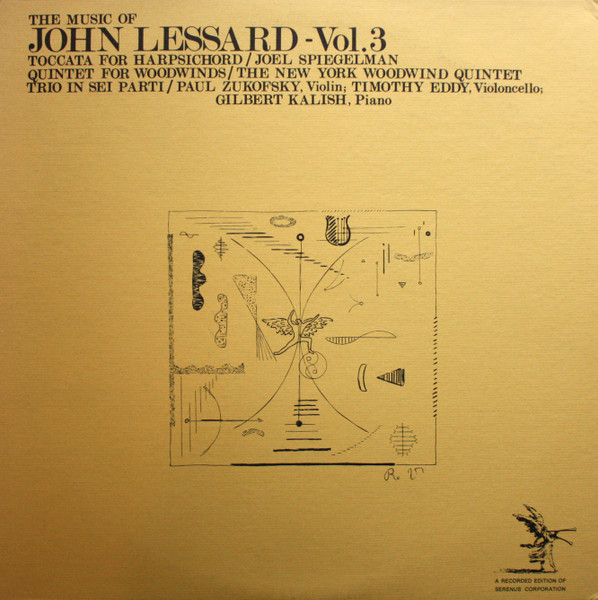
The Toccata in Four Movements is
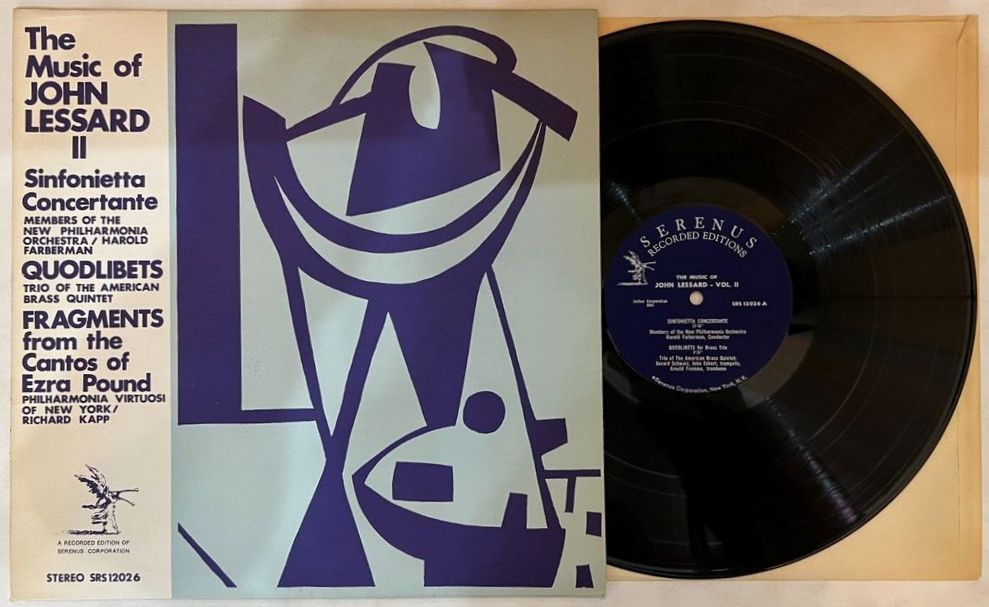
just an excellent performance. That’s on Serenus 12032 [shown above-left].
That’s for harpsichord. He put Toccata
for Harpsichord on the copy, but it’s Toccata in Four Movements. Isn’t
that something? That’s typical Paul Kapp! By the way, you may
read some of the things which are on the back as biographical material.
He was an extraordinary man, as I say. He had his ups and downs, and
his great points and his weak points. One of them, which I don’t say
is good, or bad, or anything, but he just put out all these records by himself.
He got the artwork, did this, did that, worked at night time in his own place,
putting out these covers. He would sometimes work at night time and
make the notes on the back, and he would invent my life! [Both laugh]
He would put in things and would invent the notes for the work, too.
BD: A couple
of other composers have said that the information on the back of the Serenus
Records are a little bit spurious! [More laughter] Joseph Alexander was
saying the text bears no relationship to what he’s like!
JL: The Toccata in Four Movements, which got me
the National Academy Award in Music was commissioned by Sylvia Marlowe.
She recorded it twice with different companies, but they’re out of print,
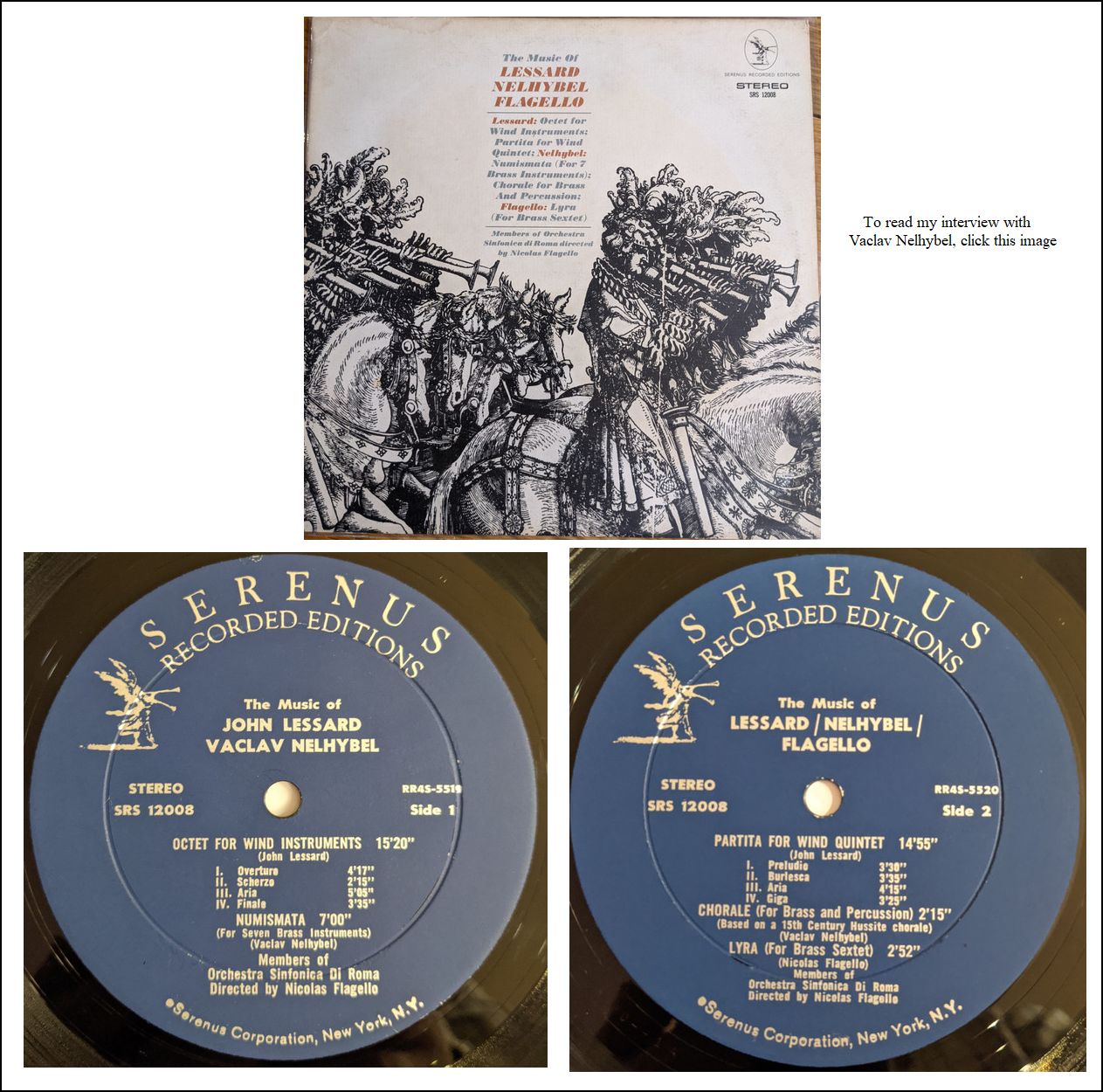
of course. The Partita for Wind Quintet
was the very first one that Kapp did. He used a very scrumply group
and the disc doesn’t even represent the work, so just don’t play
it! The members of the orchestra in Rome were more interested
in just getting a couple of bucks and then going out and having some spaghetti!
They did the presto sections andante! But the rest of the works
are OK. The Octet for Wind Instruments
is well done. Flagello conducted that and he did a good job on it.
So that’s a neoclassic work which is well-represented.
BD: How about
this new recording on the Opus One label?
JL: Opus One!
Oh, that’s just great! Because you see, you’ve got twenty years where
I don’t have, really, my music recorded at all. The last work recorded
on Serenus is from 1971, and we’re almost to ’91 now. The performers
on Opus One are excellent. Both of them had been students at New York;
now they’re professionals, but they’ve played my music for years, and we
just put that together so beautifully!
BD:
One last question. Is composing fun?
JL: Oh, I don’t
know what to call it. It’s more than fun! It’s almost like breathing
— if one gets used to it and one loves to do it. It’s an activity which
just fills up one’s life in so many sides. But of course it’s a lot
of work, too. There is the copying and getting it done, and doing
this, doing that, things that one has to do as there is for anything.
But in general, yes. It’s an activity like any other activity which
demands all kinds of work. But it’s the result that one is aiming
at that is really fulfilling, I think.
===== =====
===== ===== =====
--- --- --- ---
---
===== ===== ===== =====
=====
© 1989 Bruce Duffie
This interview was recorded in Chicago on May 6, 1989. Portions
(along with recordings) were used on WNIB in 1990, 1995, and 2000.
This transcription was made and posted on this website in 2009.
To see a full list (with links) of interviews which have been transcribed
and
posted on this website, click here. To
read my thoughts on editing these interviews for print,
as well as a few other interesting observations, click here.
* * * *
*
Award -
winning
broadcaster Bruce Duffie was with WNIB, Classical
97 in Chicago from
1975 until its final moment as a classical
station in February of 2001. His
interviews have also appeared in various magazines
and journals since 1980, and he now continues his broadcast
series on WNUR-FM,
as well as on Contemporary
Classical Internet Radio.
You are invited to visit his website for more information
about his work, including selected
transcripts of other interviews, plus
a full list
of his guests. He would also like to call
your attention to the photos and information about
his grandfather,
who was a pioneer in the automotive field more than a century ago.
You may also send him
E-Mail with comments,
questions and suggestions.