A Conversation with Bruce Duffie
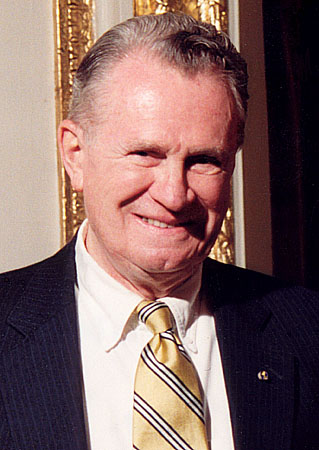
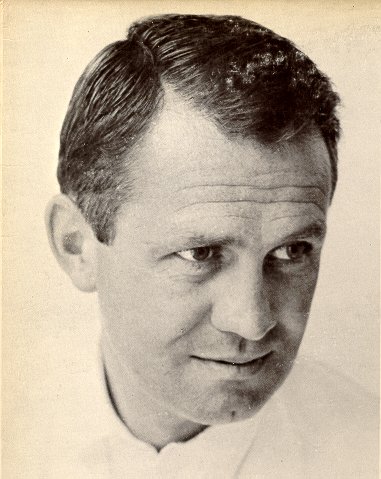
| Francis Thorne (b. Bay Shore,
New York, June 23, 1922) is an American composer of contemporary classical
music and grandson of the writer Gustav Kobbé. His father was a ragtime
pianist and his grandfather a Wagner critic. He was a student of Paul Hindemith
at Yale University, before entering the U.S. Navy in 1942 where he served
during World War II. After the war, he pursued a career on Wall Street and
later, after Duke Ellington heard him play the piano and arranged an engagement
for him at a New York jazz club, as a jazz pianist. From 1959 to 1961 he
studied composition in Florence with David Diamond, who encouraged
him to incorporate his jazz sensitivities into his symphonic compositions.
In December 1961, his first opera, Fortuna,
premiered in New York City. In 1964 Eugene Ormandy and the Philadelphia Orchestra
premiered his Elegy for Orchestra.
In 1968 he was inducted into the American Academy and Institute of Arts and
Letters. Thorne spent much of his career championing the works of emerging
composers. He served as director of the Walter W. Naumburg Foundation and
the Thorne Music Foundation from 1965–1974, organizations which commission
new works by young composers. In 1977 he founded the American Composers Orchestra
with Dennis Russell Davies.
The orchestra focuses on performing new compositions by American composers. Many of his over 100 compositions are characterized by a distinct jazz flavor. He is also one of the first classical composers to write for the electric guitar and electric bass guitar (Sonar plexus, 1968; Liebesrock, 1968–69). A discussion of his works appears in R. Tomaro: Contemporary Compositional Techniques for the Electric Guitar in United States Concert Music. Thorne lives in Manhattan. The Francis Thorne Papers (1956-2004) are held by the New York Public Library. -- Throughout this webpage, names
which are links refer to my Interviews elsewhere on this website. BD
|
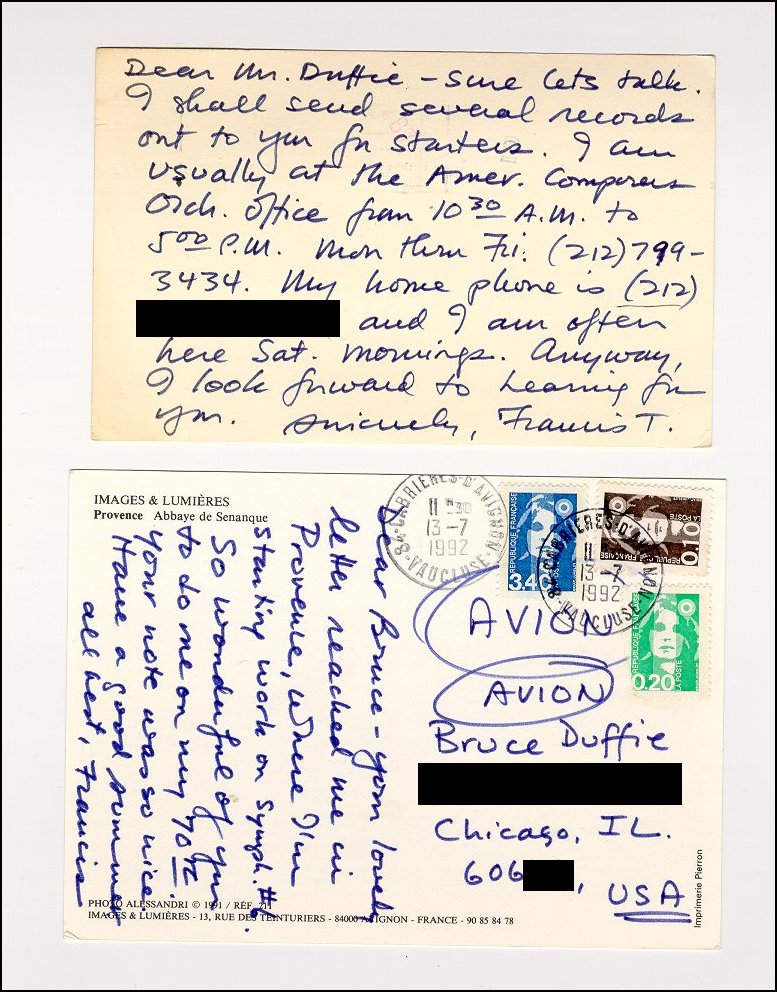 Bruce Duffie: May I speak with Francis Thorne, please?
 FT: Unlike William Schuman or Charles Wuorinen, I
do not do it during the course of a day; I divide my year. I’m talking
about the nitty-gritty of composing. I spend three months, sometimes
more, in the summer outside of New York somewhere writing music. But
that’s only part of it. Then in the winter I
do the administrative work, and the copying and the proofreading and the
promoting and the other things you have to do once the piece is written.
So I divide my year; others do it in different ways.
FT: Unlike William Schuman or Charles Wuorinen, I
do not do it during the course of a day; I divide my year. I’m talking
about the nitty-gritty of composing. I spend three months, sometimes
more, in the summer outside of New York somewhere writing music. But
that’s only part of it. Then in the winter I
do the administrative work, and the copying and the proofreading and the
promoting and the other things you have to do once the piece is written.
So I divide my year; others do it in different ways.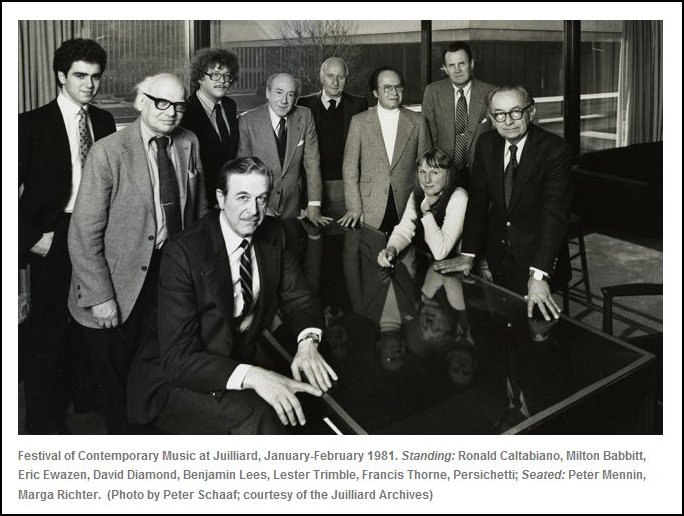
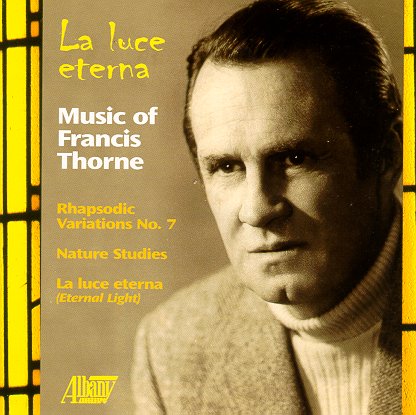 FT: I’ll give you a very specific example.
A little over twenty years ago, Ormandy played a piece of mine with the Schumann
Second Symphony, and the Chopin
E Minor Concerto. That’s where
you really want to be, because it was done three times. And of course,
if it goes on tour then it’s done more. But that’s really what everybody’s
heart’s desire is. There are many more cases where you would get on
a program of contemporary music, and a lot of times these pieces cancel each
other out. That’s one of the real problems we have with putting on
an A.C.O. program, that pieces don’t kill each other off! One way you
have to cope with that is to have pieces that are very different, so that
there’s a lot of contrast from one piece to another. But I certainly
believe it strongly that most composers would much rather be on a program
with pieces that are not contemporary, unless there’s some relationship there.
FT: I’ll give you a very specific example.
A little over twenty years ago, Ormandy played a piece of mine with the Schumann
Second Symphony, and the Chopin
E Minor Concerto. That’s where
you really want to be, because it was done three times. And of course,
if it goes on tour then it’s done more. But that’s really what everybody’s
heart’s desire is. There are many more cases where you would get on
a program of contemporary music, and a lot of times these pieces cancel each
other out. That’s one of the real problems we have with putting on
an A.C.O. program, that pieces don’t kill each other off! One way you
have to cope with that is to have pieces that are very different, so that
there’s a lot of contrast from one piece to another. But I certainly
believe it strongly that most composers would much rather be on a program
with pieces that are not contemporary, unless there’s some relationship there.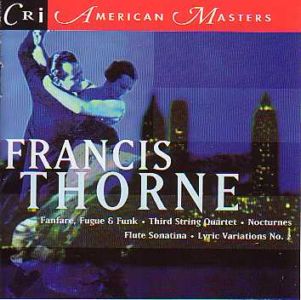 FT: Yes and no. The Seven Set Pieces are quite well performed,
and the Burlesque Overture and Rhapsodic Variations are pretty well
performed. I’m not too happy with the Liebesrock.
FT: Yes and no. The Seven Set Pieces are quite well performed,
and the Burlesque Overture and Rhapsodic Variations are pretty well
performed. I’m not too happy with the Liebesrock.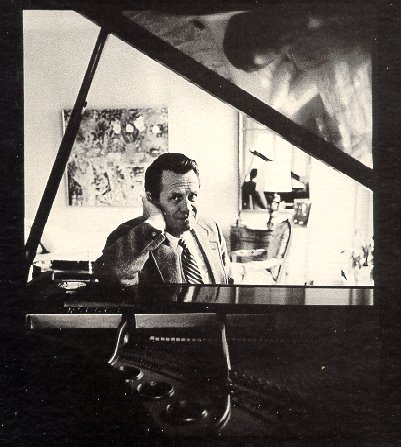 FT: It seems to me that the quality of orchestral
playing has improved. Not necessarily the great few, but there are
so many really good ensembles around. That, I think, is something that
we can really boast of in this country. Some of the best performances
I’ve had have been by the Youngstown Symphony or the Albany Symphony or the
Oklahoma Symphony. They have given me really first-class performances.
As far as the great artists are concerned, when I was a kid I heard Rachmaninoff
and Hoffmann and Flagstad. I have never heard a singer to this day
that I think could compare to Flagstad for the absolute beauty of the tone
that she poured out. I don’t suppose they are any better or any worse
pianists today than the pianists of the twenties and thirties, but I do know
that the number of first-rate orchestras is really mind-boggling today.
And of course, that is a great incentive to write for them, if they’ll only
play your stuff! [Both laugh] I think the A.C.O. is an incredible
orchestra.
FT: It seems to me that the quality of orchestral
playing has improved. Not necessarily the great few, but there are
so many really good ensembles around. That, I think, is something that
we can really boast of in this country. Some of the best performances
I’ve had have been by the Youngstown Symphony or the Albany Symphony or the
Oklahoma Symphony. They have given me really first-class performances.
As far as the great artists are concerned, when I was a kid I heard Rachmaninoff
and Hoffmann and Flagstad. I have never heard a singer to this day
that I think could compare to Flagstad for the absolute beauty of the tone
that she poured out. I don’t suppose they are any better or any worse
pianists today than the pianists of the twenties and thirties, but I do know
that the number of first-rate orchestras is really mind-boggling today.
And of course, that is a great incentive to write for them, if they’ll only
play your stuff! [Both laugh] I think the A.C.O. is an incredible
orchestra.|
Francis Thorne’s music was not performed professionally until he was 40 years old. He had been, respectively, Naval officer, banker, stockbroker, and jazz pianist. Although he had two years of study with Paul Hindemith at Yale, Hindemith discouraged a composing career. It wasn’t until he had private studies with David Diamond in Florence, Italy, that he developed the craftsmanship and confidence to pursue a professional composing career. Thorne’s first orchestral work after completing his studies with Diamond was Elegy for Orchestra. When Eugene Ormandy premiered it with the Philadelphia Orchestra in 1964, the Philadelphia Bulletin described it as “deeply felt and effective.” The success of Elegy brought Thorne back from Florence to New York, where he has been combining music administration and composing for over 35 years. His catalogue of 117 works includes seven symphonies, fifteen concerti, four string quartets, and the opera Mario and the Magician. He has been Executive Director of the Walter M. Naumburg Foundation
and the American Composers Alliance, and President and CEO of the American
Composers Orchestra since 1976. He also spent two years as Executive Director
of Lyn Austin’s Music Theater Group and, for seven years, he ran the Thorne
Music Fund which awarded three-year fellowships to American composers of
“mature years and recognized accomplishments.” Recipients of these fellowships
included Stefan Wolpe, Ben Weber, Lou Harrison, David
Diamond, Jacob Druckman,
Lucia Dlugoszewski, and Henry Brant among others. He has served on the Boards of the MacDowell Colony, The Manhattan School of Music, Composers Recordings, Inc., American Music Center, American Brass Quintet, the Group for Contemporary Music, the American Composers Alliance, and the Walter M. Naumburg Foundation. He has also served on the music panel of the New York State Council on the Arts. Thorne’s awards include the American Academy of Arts and Letters, three National Endowment for the Arts Fellowships, two Ford Foundation Recording Awards, a Fairleigh Dickinson University Award, the ACA Laurel Leaf Award, a BMI Certificate of Excellence for service to American music, and residencies with the Saint Paul Chamber Orchestra, the Cabrillo Festival (three times), Harvard University, Connecticut College, and the New Hampshire Music Festival. He has received commissions from, among others, the Seattle Symphony, Buffalo Philharmonic, Brooklyn Philharmonic, Albany Symphony (three times), Youngstown and Shreveport Symphonies, Valerie Bettis Dance Company, New Haven and Springfield Symphonies, Saint Paul Chamber Orchestra, and the Cabrillo Festival as well as numerous chamber ensembles. Other important orchestral performances have been with the Minnesota Orchestra, the Indianapolis Symphony, the Denver Symphony, the Baltimore Symphony, the Kansas City Philharmonic, the New York Pops Orchestra, the Guggenheim Concert Band, the Westchester Philharmonic, and American Composers Orchestra. Thorne lives with his wife, Ann, in New York City. He has three daughters and four grandsons. His music is published by Merion Music (Theodore Presser Company), C.F. Peters, and General Music, and is recorded on New World Records, CRI, Louisville and Serenus. He was elected in 1988 to membership in the American Academy of Arts and Letters. He also belongs to the American Composers Alliance, American Music Center, and is currently a member of the Century Association and Broadcast Music, Inc. (BMI). |
This interview was recorded on the telephone on May 3, 1986.
Portions were used (along with recordings) on WNIB in 1987, 1992 and 1997.
A copy of the audio tape was given to the Archive of Contemporary Music at Northwestern University. The transcription
was made and posted on this website in 2009.
To see a full list (with links) of interviews which have been transcribed and posted on this website, click here.
Award - winning broadcaster Bruce Duffie was with WNIB, Classical 97 in Chicago from 1975 until its final moment as a classical station in February of 2001. His interviews have also appeared in various magazines and journals since 1980, and he now continues his broadcast series on WNUR-FM, as well as on Contemporary Classical Internet Radio.
You are invited to visit his website for more information about his work, including selected transcripts of other interviews, plus a full list of his guests. He would also like to call your attention to the photos and information about his grandfather, who was a pioneer in the automotive field more than a century ago. You may also send him E-Mail with comments, questions and suggestions.