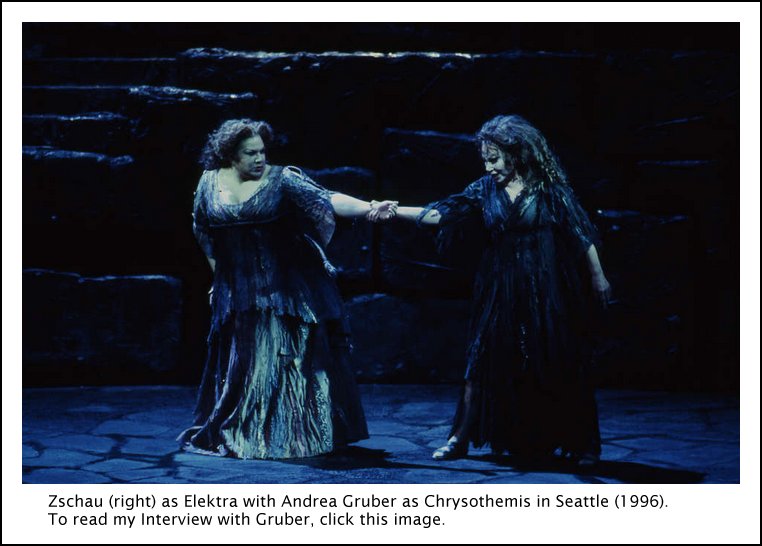
CONVERSATION PIECE:
MARILYN ZSCHAU
By Bruce Duffie
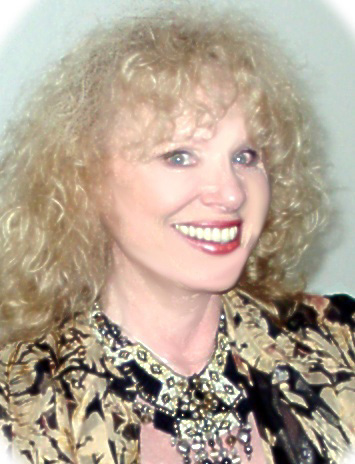
Marilyn Zschau (pronounced “Chow,” or, if you will, “Ciao”) has had many successes in opera
in both America and Europe. Born in Chicago and growing up as a tomboy
in North Carolina, she claims not to know anything about “this flirting business.”
She started out as a mezzo soprano but quickly found her true range as a
spinto/dramatic soprano. Her climb to the top has not been easy, but
her philosophy of life allows her to be patient – things which she should
do eventually come her way.
Among the things which have already come her way are leading roles romantic,
verismo, and contemporary operas. Frequent characters include Tosca,
Santuzza, Manon Lescaut, Odabella (in Attila),
Maddalena (in Andrea Chenier), Barak’s
Wife (in Die Frau Ohne Schatten),
Leonora (in La Forza del Destino),
and Minnie (in La Fanciulla del West).
She has also scored success in contemporary works such as Korngold’s Die Tote Stadt, Lady Macbeth Mtsensk by Shostakovich,
and Thomas Pasatieri’s Before Breakfast.
The following conversation took place in the fall of 1982, during one of
Miss Zschau’s visits to Lyric Opera of Chicago.
Bruce Duffie: First, let me
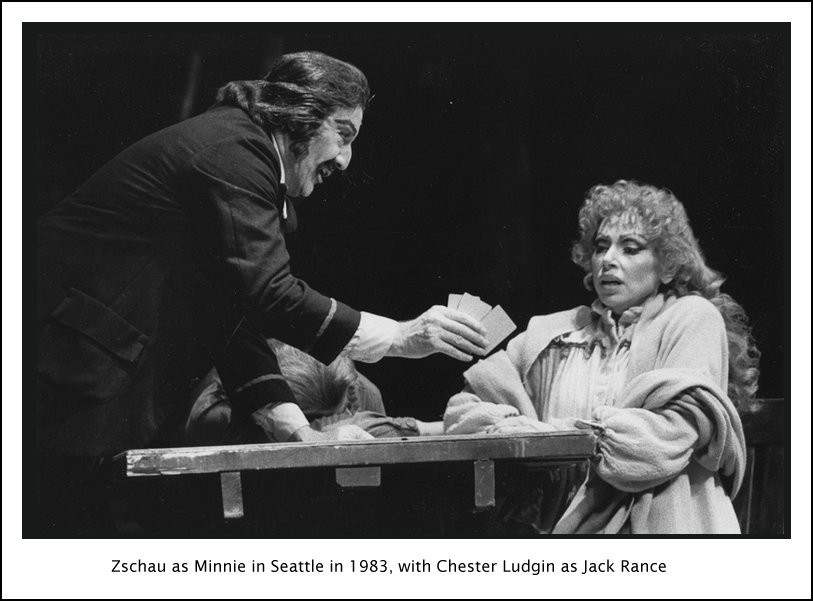
ask you about one of your famous roles – Minnie. What is she really
like?
Marilyn Zschau: Basically,
she is a very honest person who falls into the trap of cheating at cards
because there just doesn’t seem to be any other way out. I think that
audiences should forgive her for that because she’s doing it to save somebody’s
life, and I think that that is very admirable. They’re trying to hang
Dick Johnson for something he didn’t do. He admits being a thief, but
he says he’s never killed anyone. She believes him and Jack Rance doesn’t,
and she realizes that Rance is totally unscrupulous. Rance gives her
his word that he will not chase after Johnson, but as soon as the man is
well again, they go after him and string him up... So, she has to save
him again.
BD: Is Minnie a virgin?
MZ: Yes. Oh yes, definitely.
In the last act she says to the men that she’s given up her youth for them
and been mother and sister to them, and taken care of them as a cook and
maid, and been their friend. And when she’s talking to Johnson, she
remarks, “I don’t understand how somebody can love somebody just for an hour.”
BD: Is she happy at the end
when she goes off with Johnson?
MZ: Oh I think so. It’s
a bittersweet situation – she’s happy and yet unhappy about leaving the boys
and that place in California which has been her home. So it’s sadness
mixed with unhappiness. She’s got him, but she’s had to give up everything
she’s known until then.
BD: Why is Fanciulla not known as much as Butterfly or Tosca?
MZ: I think it’s a bit more
difficult to grasp melodically and musically. For the audience there’s
a great deal of talking – particularly in Act I – and if you don’t understand
it, it can seem like a great deal of music about nothing.
BD: Would it work in translation?
MZ: I don’t know. I’ve
never done it in translation. I’ve read the translation in my score
and it’s really quite laughable. Someone would have to do a really
careful translation of it; get a poet to do it so that it sounds as poetic
as what’s already there because the Italian is really quite lovely.
It has some wonderful sentiments, but you have to know what it is.
I’ve met a number of people who say the second or the third or the fourth
time they heard Fanciulla they liked
it a lot better than the first. It grows on you. It doesn’t make
the wonderful first impression that Bohème
does, or Manon Lescaut where the
melodies are all right there one after another. This one has everything
sort of intertwined and it’s much more complex. I enjoy it for that
reason.
BD: Let me ask about translations
in general – do you like them at all?
MZ: It’s good for the audience
– if you can understand us. Sometimes operas are so dramatically difficult
that it’s difficult to get all the words across through the orchestra.
But for myself? No. They usually don’t fit; the vowels don’t
fit the same way. The composer has spent a great deal of time writing
the musical line to make it easy – or as easy as possible
– for the singer to sing the particular vowels that he has chosen
on the particular pitches. Invariably, you get a different vowel, and
especially for a female voice it is very difficult on a higher pitch.
Sometimes they will stick a word on B or C that have “e’s” in them, which
is ridiculous. You cannot sing a pure “e” vowel up there without sounding
terrible. You can sing a squeaky “e” and sound like a mouse, but that’s
not what the audience pays to hear. A man can sing pure vowels up to
the top of his range, but that’s because he’s still an octave below where
I am. But it’s difficult to project any language. I was working
on a piece with Thomas Pasatieri a few years ago, and he had written some
very awkward things. He could sing them fine, but I couldn’t, and he
changed them. He and Frank Corsaro had written the piece and we wanted
to change a few words around, and Frank said sure. They were very flexible,
thank God, because there were a couple of phrases which were just impossible
to sing.
BD: You can do that with a
living composer, but do you sometimes wish that you could get Verdi or Puccini
to do the same kind of alteration?
MZ: Once in a while I think,
“If they’d only not written that word up there…” There are some phrases that
are very difficult, and you have to cheat. You find those spots and
work on them very carefully.
* *
* * *
BD: In a role like Minnie,
where there only a couple of you singing it around the world, do people compare
you with Carol Neblett?
MZ: I’m sure they must among
themselves, but they don’t come to me and say, “Well, she did this better,
but you do that better.” I have not heard a criticism that compares
us.
BD: Does it bother you at all
knowing that a good portion of the audience will have heard the recording
with her?
MZ: No. If they come
to the opera and they’ve got an impression of one person singing the role,
they’ve got to be ready for a different voice and different personality and
a different characterization. If they’re not flexible, then they should
stay at home.
 BD: Is Puccini easy to sing?
MZ: In Puccini, you’ve got
to know how to sing loud because the orchestration is so thick. Most
of his parts are a whole tone too low for me. The whole tessitura is
too low. I like the tessitura of the Verdi operas like Forza and Travatore and even Attila. You can get up into your
head voice and feel more comfortable. In Puccini you’ve got to concentrate
all your energy in the middle of your voice, and you get tired, extremely
tired. I was speaking with Alfredo Kraus yesterday
about Butterfly and he told me that
in Italy and Spain many young lyric sopranos ruin their voices trying to
sing that role. It is for a spinto soprano. It’s too low, it’s
too long, it’s too heavy, and it’s too thick. If you don’t know how
to sing really well and how to pace yourself, you should stay away from Butterfly. It’s a real killer.
But Verdi, on the other hand, has the phrases which lie really beautifully
for the voice. He seemed to know a great deal about singing.
The accompaniment is never so thick as in Puccini. In Verdi, you don’t
have to compete with the orchestra or fight with it. If you have an
insensitive conductor for Puccini, it can be very difficult – especially
if they want it loud.
BD: What can you do then?
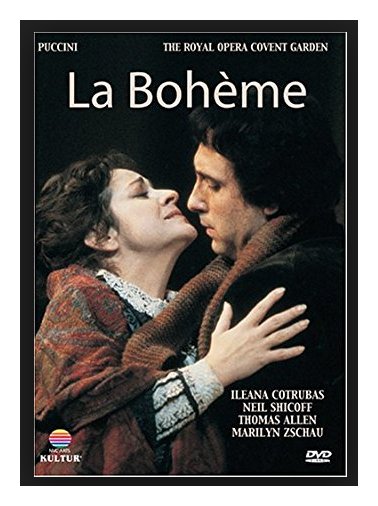
[Vis-à-vis the DVD shown at right,
see my Interviews with Ileana Cotrubas, Neil Shicoff, Thomas Allen, and
Gwynne Howell (Colline).]
MZ: I ease off. I figure
why should I push? I’m not going to get more volume by pushing.
I just relax and figure it might pop out easier, and it usually does.
BD: Does the size of the house
affect that kind of thing?
MZ: I think so. It’s
much easier to sing Puccini in a smaller house with good acoustics because
you can hear the voice riding over the orchestra. In a very large theater
– like this one in Chicago – it takes longer for the sound to hit the walls,
so the reverberation time is longer. You don’t really get instant playback
from what you’re giving out, so you just have to trust the feeling of it.
You have to know how your voice feels when it’s right. I remember one
performance when it was muggy and rainy and the atmospheric pressure was
heavy, and the acoustics were very different. Everyone was complaining
that night; it was definitely more “dead” in the house.
BD: Do you like working with
a scrim?
MZ: In the beginning I used
to hear so many horrible stories about how awful scrims were that I thought
they were terrible, but I haven’t ever heard any complaints when I’ve had
them. I don’t think it affects the sound dramatically. It may
take a tiny bit of the sound away, but it doesn’t bother me. I don’t
think about them. I haven’t studied stagecraft or scenic design.
BD: Do you like all the new
ideas that are being brought into various productions?
MZ: I haven’t seen the famous
Aïda in Frankfurt, but I understand
that it’s raised the attendance level, so I guess it’s good for something.
That production has the whole thing take place in an office.
Now that’s totally out-to-lunch as far as I’m concerned, and not at all what
Verdi had in mind, but if it gets people coming to the opera and talking
about it, and if they then are interested enough to come to a “normal” production,
then it’s done a good job.
BD: Would you do a Fanciulla where you come in on motorcycle
instead of a horse?
MZ: Sure, why not. If
you can interest a younger audience that way and get people to like the opera
better, fine. You can’t change the basic fabric of the music.
BD: Is that the way to get
more people to come to the opera?
MZ: It might be for certain
places. In Germany, particularly, they’re sort of far-out as far as
theater goes. They do a lot of strange and experimental things so it’s
sort of expected, but, there must be a certain amount of the German public
that appreciates the traditional. I know they had a wonderful production
of Eugene Onegin at the Munich Opera,
and it was a huge success. It was old-fashioned and beautiful, and
they liked it, but they kind of have to be extremely beautiful. Otto
Schenck did that beautiful Tannhäuser
at the Met with wonderful huge sets like Wagner must have envisioned for
that piece. What I like in opera is wonderful direction; it is best
if you’ve got a director that can get performances out of the singers.
I really loathe opera where you go to see a drama and all you get are people
standing on the front of the stage singing.
BD: If you’re involved in something
like that, do you try to inject some drama into the proceedings?
MZ: I try, but sometimes you
have to fight the director. If they have the concept of something static
and they’re just making pictures, you might as well just give up and do it
the way they want and get bad reviews for being static and stiff. That’s
usually what happens to us – we get blamed for the bad performances and the
director gets praised when we do well. If we do something for ourselves,
the director gets the credit for such a wonderful job or directing us, and
usually he hasn’t.
* *
* * *
BD: Can I assume you enjoy
singing?
MZ: I don’t always enjoy it
– it depends on the conductor. I did a production of Tosca in Wales recently that was really
painful. We had a wonderful conductor from Russia – Mark Ermler – who
had a very warm personality and was a very nice man and a sensitive musician
and a good conductor, but his tempi were so slow he nearly killed all of
us. It was physically painful. Our abdominal muscles were sore
for holding phrases really longer than they were meant to be.
BD: Would an apt comparison
be to ask a person who does the 100 yard dash to run a mile?
MZ: Yes, or a miler to do a
marathon. I was telling someone recently that doing Giulietta in The Tales of Hoffman is like revving
up to do a marathon and then doing a 100 yard dash. You get to the
end and you think, “Oh… it’s all over.” I’ve warmed up for 40 minutes
to sing 30 minutes of music.
BD: Do you feel cheated?
MZ: I do a little bit.
Offenbach was pretty bad to Giulietta. He wrote a very nice aria for
Olympia and a very nice aria for Antonia and not a darn thing for poor old
Giulietta. All she gets is a measly little duet with a pretty tune
that’s too low, and a sextet that’s too high. It’s terribly difficult
to sing.
BD: Will you keep this in mind
and turn down further offers for it?
MZ: I probably would not do
it again because it’s just a lot of effort for 30 minutes.
BD: Would you ever sing all
three parts?
MZ: One of my teachers is a
former coloratura soprano in Vienna – she is Lucia
Popp’s teacher – and she told me to learn Olympia and
sing all three parts, but I think people expect a lighter, more bell-like
sound than I could ever produce. My voice is too big for that sort
of role.
BD: Ever want to do Norma or
Brünnhilde?
MZ: I’d like to
– in fact I was offered Norma, but it was at a time I wasn’t free.
For that role, though, I’d take a lot of time to prepare it and do it right.
BD: Do you enjoy contemporary
music?
MZ: No. It’s too angular.
Composers don’t know anything about the voice. They think you can flit
around from high notes to low notes without going into any notes in between
– like an instrument. It’s extremely difficult for a voice to switch
from head to chest; it was difficult when Mozart did it in “Come scoglio”
in Così Fan Tutte. I
shouldn’t generalize, I know, but most modern composers have not studied
singing and do not know anything about it. I wish that they all would
go have a few singing lessons to realize the problems.
BD: You don’t want them to
treat you like a clarinet?
MZ: No, no, no. I want
them to treat me like a human being with nice, little, tiny, skinny vocal
cords that need time to adjust. I think even conductors should study
singing. It’s a definite must for a conductor to know about breathing.
Some of them have no idea that you need a split-second for a breath.
They will give you a full second, and the music stops. That was one
of the troubles with that Russian conductor in Wales. He kept giving
me more and more time and I kept getting tighter and tighter; there was no
more spontaneity left.
BD: Couldn’t you talk
to him about this problem?
MZ: I did. For that particular
problem I told him that I would do two phrases in one breath and he was not
to give me any breath-space. I breathed, but he never knew it.
BD: Do you generally turn down
offers to do modern works?
MZ: Yes. Lady Macbeth by Shostakovich is the most
modern thing I do. Before Breakfast
by Pasatieri is different because he’s a neo-romantic. He really writes
melodies and is very careful. That piece is not too melodic, but it
was on that triple bill of one-act American operas done at the New York City
Opera. Mine was in the middle of the three, so I was the meat in the
sandwich. Many people liked it the best. It’s a monologue – 40
minutes, one character, based on a play by Eugene O’Neil.
BD: Reminds me of La Voix Humaine by Poulenc, or Schoenberg’s
Erwartung.
MZ: People often say I should
do Erwartung so eventually I’ll look
at it and decide. I’ve turned down Lulu because when it was offered to me
I wasn’t vocally solid enough to sing it. I felt I couldn’t do it justice.
Whenever I’ve seen it, I felt I could play it better than whomever I’ve seen.
My voice seems to be getting easier in the high range the older I get, and
I’m still learning things about my voice. I started out as a mezzo and
was trained as a mezzo, so that gave me a lot of vocal problems that most
sopranos don’t have. I was twisted in knots and had to get the knots
out of my throat. And it’s taken a long time because I’ve been working
at the same time. I never took a year or two years off to just study.
I had to keep working because I had to keep making money. I was supporting
myself and didn’t have any extra money to take two years off.
* *
* * *
BD: Do you enjoy all the travel
that comes with a career like yours?
MZ: Yes. It’s not so
boring as living in one place all the time. I was in Zurich, Switzerland,
for 10 years and didn’t go anywhere and didn’t do anything, and it was horrible.
I enjoy seeing new people and traveling to new theaters and being here and
there and everywhere. The bad part is packing. Somehow your clothing
always seems to multiply. Even if you don’t buy anything new, they
just get bigger and won’t go back in the suitcase the way they did the first
time.
BD: How often do you sing?
 MZ: I like to have two days in between performances.
I don’t like to sing every other day. It’s extremely difficult and
it’s wearing on the body and the throat. I don’t think vocal cords
are meant to take that much. There is always a certain amount of strain
in a performance no matter how good your technique is. You’re going
to do something wrong; you’ll make a mistake or miscalculate a placement
of a high note, and it’s going to throw you off a little bit. No matter
how perfect anyone sounds, you’re going to be slightly – or extremely – tired
after a performance. The next day is very difficult after a big role
like Butterfly or Odabella or Minnie. After any of those long parts
that are very dramatic, I don’t like to do anything the next day
– not even talk. I don’t do any singing; I don’t study.
I don’t sing on the day of, or the day after a performance. I can do
a little bit of singing the day before. In New York I was trying to
learn Attila at the same time as
the Pasatieri. Before one of the performances, I worked for an hour
and a half on the Verdi, and I had a really difficult time with the Pasatieri.
So I learned my lesson and I never work that much the day before a big performance.
I’ll do vocalizes and I’ll do roles that I know already, but nothing new
– especially now that I’m doing such long and difficult roles. Singing
is a very difficult business and I don’t think too many people realize just
how difficult it really is.
MZ: I like to have two days in between performances.
I don’t like to sing every other day. It’s extremely difficult and
it’s wearing on the body and the throat. I don’t think vocal cords
are meant to take that much. There is always a certain amount of strain
in a performance no matter how good your technique is. You’re going
to do something wrong; you’ll make a mistake or miscalculate a placement
of a high note, and it’s going to throw you off a little bit. No matter
how perfect anyone sounds, you’re going to be slightly – or extremely – tired
after a performance. The next day is very difficult after a big role
like Butterfly or Odabella or Minnie. After any of those long parts
that are very dramatic, I don’t like to do anything the next day
– not even talk. I don’t do any singing; I don’t study.
I don’t sing on the day of, or the day after a performance. I can do
a little bit of singing the day before. In New York I was trying to
learn Attila at the same time as
the Pasatieri. Before one of the performances, I worked for an hour
and a half on the Verdi, and I had a really difficult time with the Pasatieri.
So I learned my lesson and I never work that much the day before a big performance.
I’ll do vocalizes and I’ll do roles that I know already, but nothing new
– especially now that I’m doing such long and difficult roles. Singing
is a very difficult business and I don’t think too many people realize just
how difficult it really is.
BD: Is the public more sophisticated
about opera today than, say, ten years ago?
MZ: I think so. They’re
much more aware. Pavarotti has done a great deal to interest more people
in opera, and he’s done a great deal for young singers. I saw the Bohème he did with his contest
winners, and he didn’t act like a “star” with them – as he has sometimes
done with other productions. So, I have a lot more respect for him
because of that.
BD: Are singing contests of
any value?
MZ: I don’t think they are.
I think they’re worthless. I was in a couple and didn’t win a thing,
and here I am having a career, and those who won are nowhere to be seen.
So what does that show? It can show that you are a good competitor,
and it can show that you have a good voice. It doesn’t show that you’ve
got what it takes. It takes more than a good voice to have a career.
The nervous strain is much more at an audition, for example, and it’s purely
objective. Opera schools and opera studios connected with the big companies
are a much better idea. The one here in Chicago is a fine example.
Getting to sing a few small parts in the big companies is great training
– as long as you don’t get stuck in the small parts. However, if you
want to work full-time on big roles in smaller houses, I’m afraid the answer
is still Europe. They have the year-round houses for the young singers.
The competition for the (comparatively) few roles here must be fierce.
BD: Are there too may singers
today?
MZ: Probably. I don’t
know – it’s difficult for me to say. Some people are lucky and some
people aren’t lucky. And some people who aren’t as talented as other
people have more luck and are in the right place at the right time, and get
the job that perhaps someone else should have had. And there are others
who are pushed for one reason or another. They make big splashes and
then die out and vanish, and you wonder why such a fuss was made over that
person. Sometimes it can be money or influence. I don’t know
anything about that because I auditioned and got a job, and auditioned someplace
else and got another job; so I got mine through auditioning.
BD: Did you sing any auditions
that did not produce jobs?
MZ: I don’t think I ever sang
for anyone where I didn’t get hired for one thing or another. Then
after being in Zurich for 10 years, I didn’t have to audition any more –
my agent just sent me places where I was wanted.
BD: You’ve mentioned doing
a few things with this or that internationally-famous name. Is it better
to work with well-knowns than with unknowns?
MZ: It depends on whether the
colleagues are nice; that’s what really counts in performances. If
you’ve got a really great singer with a horrible personality, who is mean
and nasty and tries to upstage you, you don’t like that experience.
I haven’t had that experience very often, fortunately. I’ve been very
lucky and things I’ve wanted to do have eventually come my way. Maybe
not this year or next year but in the following years they come. I think
you kind of make your own reality. If there are certain things you
want to do, eventually you will get to do them.
===== =====
===== ===== =====
----- ----- -----
===== ===== ===== =====
=====
Bruce Duffie is a staff announcer and the Public Service Director with WNIB,
Classical 97 in Chicago. He also contributes interviews with operatic
artists to several local magazines. In the next issue of The Opera Journal, a conversation with
stage director Nathaniel
Merrill.
== == == ==
== == ==
--- --- ---
== == == == == == ==
© 1982 Bruce Duffie
This interview was recorded in Chicago on October 7, 1982.
Portions were used (along with recordings) on WNIB in October of 1988.
The transcription was made in 1985 and published in The Opera Journal in March of 1986.
It was slightly re-edited and posted on this website in 2009.
To see a full list (with links) of interviews which have been transcribed
and posted on this website, click here.
Award -
winning broadcaster Bruce Duffie was with WNIB, Classical
97 in Chicago from 1975 until its final moment
as a classical station in February of 2001. His
interviews have also appeared in various magazines and journals
since 1980, and he now continues his broadcast series on WNUR-FM.
You are
invited to visit his website
for more information about his work, including
selected transcripts of other interviews, plus a full
list of his guests. He would also like to call your
attention to the photos and information about his grandfather,
who was a pioneer in the automotive field more than a century ago.
You may also send him E-Mail
with comments, questions and suggestions.