 MG: Yes, I think it is.
For one thing, I expect a certain
amount of resistance. I'm speaking now about a work that's heard
for the first time. There will be a certain amount of resistance,
probably unconscious resistance because it's new. It's hard to
hear new things. On the other hand, I expect a certain amount of
curiosity and willingness and, I suppose, sympathy — unless
there's some reason why they don't feel sympathetic. There are
all kinds of prejudices that come into play. So it's a
combination of resistance and interest, sympathy and enthusiasm.
That's about the mixture that I feel I get from audiences. Even
if it's not a large audience or even if it's just friends in a room
listening to something of mine, I have a very strong sense of how
they're feeling, how they're experiencing the music. I don't
really have any proof that I'm right, but in a larger audience you have
ways of telling by applause and by the kind of things they say.
They're very, very different at different times; there are times when I
feel the whole audience is with me and times when I feel that it's more
scattered.
MG: Yes, I think it is.
For one thing, I expect a certain
amount of resistance. I'm speaking now about a work that's heard
for the first time. There will be a certain amount of resistance,
probably unconscious resistance because it's new. It's hard to
hear new things. On the other hand, I expect a certain amount of
curiosity and willingness and, I suppose, sympathy — unless
there's some reason why they don't feel sympathetic. There are
all kinds of prejudices that come into play. So it's a
combination of resistance and interest, sympathy and enthusiasm.
That's about the mixture that I feel I get from audiences. Even
if it's not a large audience or even if it's just friends in a room
listening to something of mine, I have a very strong sense of how
they're feeling, how they're experiencing the music. I don't
really have any proof that I'm right, but in a larger audience you have
ways of telling by applause and by the kind of things they say.
They're very, very different at different times; there are times when I
feel the whole audience is with me and times when I feel that it's more
scattered.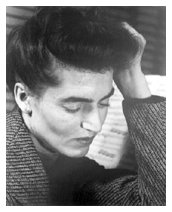 MG: Oh, I don't do that.
In the past I've written what I
felt like writing and most of the time it was performed. In the
last 15 or 20 years I have had commissions offered, or performers have
said, "If you will write such-and-such, we'll play it on such-and-such
a day." It's the performance that attracts me, so that's the way
I've been working. I've been lucky, I guess. When I started
composing and getting performances, there weren't nearly as many
composers around, let alone women composers. I think it was much
easier to get performances; I don't remember trying. I studied
with Lazare Saminsky [(1882-1959), Ukrainian Jewish performer,
conductor, and composer, who focused on Jewish music] and with Roger
Sessions [(1896-1985), American composer]. They were really my
principal teachers, and were instrumental in a lot of music-making
organizations, like the League of Composers [founded in New York City
in 1923 as an American arm of the International Society for
Contemporary Music] and the ISCM [established in 1922 in Salzburg,
Austria]. They saw to it that young composers that they were
interested in got performances.
MG: Oh, I don't do that.
In the past I've written what I
felt like writing and most of the time it was performed. In the
last 15 or 20 years I have had commissions offered, or performers have
said, "If you will write such-and-such, we'll play it on such-and-such
a day." It's the performance that attracts me, so that's the way
I've been working. I've been lucky, I guess. When I started
composing and getting performances, there weren't nearly as many
composers around, let alone women composers. I think it was much
easier to get performances; I don't remember trying. I studied
with Lazare Saminsky [(1882-1959), Ukrainian Jewish performer,
conductor, and composer, who focused on Jewish music] and with Roger
Sessions [(1896-1985), American composer]. They were really my
principal teachers, and were instrumental in a lot of music-making
organizations, like the League of Composers [founded in New York City
in 1923 as an American arm of the International Society for
Contemporary Music] and the ISCM [established in 1922 in Salzburg,
Austria]. They saw to it that young composers that they were
interested in got performances. 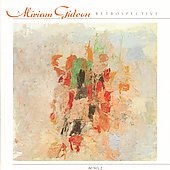 MG: Yes, I can honestly say
that I feel very, very
fortunate. I don't think there's a single recording
— and I have quite a few — where
the performers are not first-rate. They are so special; they're
so devoted to contemporary music; they're so proficient; they have such
good sound, which is very important whether you're a singer or an
instrumentalist. And there's no end of work that they will not
do. They're just remarkable people to work with. There
isn't a single record that I don't feel is pretty close to what I
want. I'm happy to say that and I can't say it enough.
MG: Yes, I can honestly say
that I feel very, very
fortunate. I don't think there's a single recording
— and I have quite a few — where
the performers are not first-rate. They are so special; they're
so devoted to contemporary music; they're so proficient; they have such
good sound, which is very important whether you're a singer or an
instrumentalist. And there's no end of work that they will not
do. They're just remarkable people to work with. There
isn't a single record that I don't feel is pretty close to what I
want. I'm happy to say that and I can't say it enough.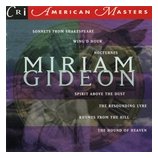 MG: That's in fact the earliest
piece of all my recorded pieces. It was written in the very early
1940s, and I wrote it for string
quartet. I was still studying with Roger Sessions then, and
strangely enough, there seemed to be more opportunity to get
it played by a string orchestra than by a string
quartet! You would think the opposite, but that's the way it
worked
out! As a matter of fact, my very first recording — outside
of a very early one — is a symphony, the Symphonia
Brevis. You would think that would be the hardest kind
of thing to get recorded, but these opportunities came up in connection
with the
American Composers Alliance, of which I'm a member. They're
closely connected with CRI. At that
point they were doing a lot of recording in Europe because it
was less expensive, and there was a chance to get
some orchestral works recorded. So they took my Symphonia Brevis,
and it was done in Zurich conducted by Jacques
Lenot. I
had already a string orchestra arrangement of the Lyric Piece because there had
been a local performance of it, so they also took that and it was
done in Tokyo! It's a
rather intense work in one movement, and has a great deal
of... [thinks for a moment] ... it's kind of hard to use any
word but "lyric" quality.
MG: That's in fact the earliest
piece of all my recorded pieces. It was written in the very early
1940s, and I wrote it for string
quartet. I was still studying with Roger Sessions then, and
strangely enough, there seemed to be more opportunity to get
it played by a string orchestra than by a string
quartet! You would think the opposite, but that's the way it
worked
out! As a matter of fact, my very first recording — outside
of a very early one — is a symphony, the Symphonia
Brevis. You would think that would be the hardest kind
of thing to get recorded, but these opportunities came up in connection
with the
American Composers Alliance, of which I'm a member. They're
closely connected with CRI. At that
point they were doing a lot of recording in Europe because it
was less expensive, and there was a chance to get
some orchestral works recorded. So they took my Symphonia Brevis,
and it was done in Zurich conducted by Jacques
Lenot. I
had already a string orchestra arrangement of the Lyric Piece because there had
been a local performance of it, so they also took that and it was
done in Tokyo! It's a
rather intense work in one movement, and has a great deal
of... [thinks for a moment] ... it's kind of hard to use any
word but "lyric" quality.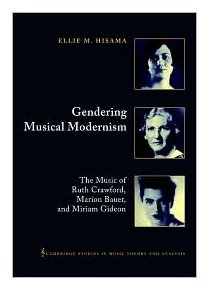 MG: [Chuckles]
I have to be flippant and say I've never been anything else, nor have I
have I lived in any other century. But I will say that I
really was not aware of being a woman composer until somewhere in the
'60s when there was a lot of talk about
it. Then I had to be aware of it and began to reflect
on my experiences. When people asked if I was discriminated
against, I always said, "No, no,
no! No, not me!" I really was
treated like a composer — a young composer, and then at
some point
which you couldn't ascertain, not a young composer — but in
those terms, not a woman composer. But as I looked at it more
carefully, and I got to the stage where I was often a
judge on a panel of other composers, I realized that
there are all kinds of discrimination which one isn't aware of, and
that probably there was discrimination
against women composers. I think there still is, in spite of the
best
intentions. I really think so.
MG: [Chuckles]
I have to be flippant and say I've never been anything else, nor have I
have I lived in any other century. But I will say that I
really was not aware of being a woman composer until somewhere in the
'60s when there was a lot of talk about
it. Then I had to be aware of it and began to reflect
on my experiences. When people asked if I was discriminated
against, I always said, "No, no,
no! No, not me!" I really was
treated like a composer — a young composer, and then at
some point
which you couldn't ascertain, not a young composer — but in
those terms, not a woman composer. But as I looked at it more
carefully, and I got to the stage where I was often a
judge on a panel of other composers, I realized that
there are all kinds of discrimination which one isn't aware of, and
that probably there was discrimination
against women composers. I think there still is, in spite of the
best
intentions. I really think so.|
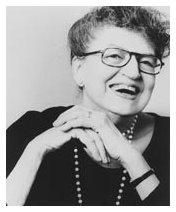
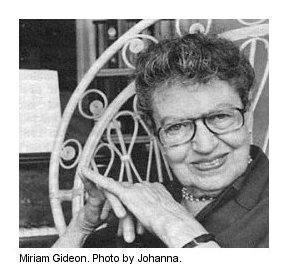
Miriam Gideon (October 23, 1906 - June 18, 1996) She studied organ with her uncle Henry Gideon and piano with Felix Fox. She also studied with Martin Bernstein, Marion Bauer, Charles Haubiel, and Jacques Pillois. She studied harmony, counterpoint, and composition with Lazare Saminsky and at his suggestion also composition with Roger Sessions after which she abandoned tonality and wrote in a freely atonal or extended post-tonal style. Born in Greeley, Colorado, she moved to New York City where she taught at Brooklyn College, City University of New York (CUNY) from 1944 to 1954 and City College, CUNY from 1947 to 1955. She then taught at the Jewish Theological Seminary of America at the invitation of Hugo Weisgall in 1955, and at the Manhattan School of Music from 1967 to 1991. She was rehired by City College in 1971 as full professor and retired in 1976. In 1949 she married Frederic Ewen. Both political leftists, they become victims of McCarthyism, Ewen resigning from Brooklyn College to avoid naming names, Gideon being fired from the same and resigning from City College to also avoid naming leftist colleges. Gideon composed much vocal music, setting texts by Francis Thompson, Christian Morgenstern, Anne Bradstreet, Norman Rosten, Serafin and Joaquín Quintero and others. She was the second woman inducted into American Academy and Institute of Arts and Letters in 1975, Louise Talma being the first in 1974. |
This interview was recorded on the telephone on June 18,
1986. Portions were used (along with recordings) on WNIB later
that year and again in 1996. An audio copy was placed in the
Archive of Contemporary Music at Northwestern University. The
transcription was made and posted on this
website in 2009.
To see a full list (with links) of interviews which have been transcribed and posted on this website, click here.
Award-winning broadcaster Bruce Duffie was with WNIB, Classical 97 in Chicago from 1975 until its final moment as a classical station in February of 2001. His interviews have also appeared in various magazines and journals since 1980, and he now continues his broadcast series on WNUR-FM, as well as on Contemporary Classical Internet Radio.
You are invited to visit his website for more information about his work, including selected transcripts of other interviews, plus a full list of his guests. He would also like to call your attention to the photos and information about his grandfather, who was a pioneer in the automotive field more than a century ago. You may also send him E-Mail with comments, questions and suggestions.