 BD: What are some of the
specific difficulties, or perhaps easy ways of getting a piece of music
from a piano work or an orchestral work into the accordion?
BD: What are some of the
specific difficulties, or perhaps easy ways of getting a piece of music
from a piano work or an orchestral work into the accordion?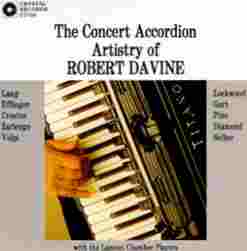 RD: Right.
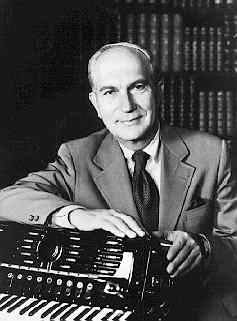
| Robert Davine (April 5, 1924 -
November 25, 2001) was a professor and theory department chair at the
Lamont School of Music at the University of Denver. He was acclaimed as
a true virtuoso of the concert accordion. He is one of the few gifted
musicians whose artistry released the exciting range of tone and color
intrinsic in the character of this unique instrument.
An artist with an international reputation as a distinguished soloist, chamber musician and teacher, Robert Davine held degrees from Northwestern University, and studied with Andrew Rizzo, Robert Delaney, Joseph Biviano, and John Serry. Mr. Davine performed as soloist with the Denver Symphony Orchestra, the Pittsburgh Symphony Orchestra, the Mantovani Orchestra of London, the Paganini String Quartet, the Norwegian Broadcasting Company, Oslo, the Aspen Music Festival Orchestra, the Flagstaff Festival Orchestra and the Lake Superior Chamber Orchestra. For many years he was staff accordionist for the National Broadcasting Company. In 1984 he was invited by the Ministry of Culture, People's Republic of China, to perform and give master classes, and many Chinese music students came to DU afterward. His artistry has inspired new compositions by composers Normand Lockwood, Cecil Effinger, Max DiJulio, Jean Berger and Wendel Diebel. He has been honored as Faculty Member of Distinction and Alumnus of Distinction at Northwestern University. In addition to teaching and performing, Mr. Davine was engaged in writing a book on the history of the accordion and its literature. He recorded for the Crystal Record Company. In 1954 he founded the accordion program at the Lamont School of Music. Theoretical studies include working with John Kirkland, Anthony Donato, Robert Delaney, Philip Werner and Frank Cookson. He researched and wrote articles on the music on India and the works of Bernard Molique and George MacFarren. During his tenure at Lamont, Professor Davine developed graduate seminars in analytical techniques as applied to twentieth century composers. "He proved himself to be one of the world's great accordionists,'' said William Popp, the U.S. Air Force's only accordionist, who was taught the instrument by Davine at the University of Denver. "From the first day, he impressed upon the students that he was welcoming them to learn.'' As a 10-year-old in 1930s Denver, Davine encountered the accordion as an accompaniment for a Spanish dance troupe. By the 1950s, "every kid on the block'' had an accordion, Mr. Davine said in a recent interview with the Rocky Mountain News. In 1954, Mr. Davine married Jacqueline. She survives him, along with his son, Greg, of Greenwood Village; daughter, Lynn Carolus, of Parker; brother, Fred, of Greenwood Village; and four grandchildren. The accordion's popularity waned as Lawrence Welk gave way to zydeco, but Mr. Davine stayed true to the rare concert accordion. He elevated it to an instrument that would accompany orchestras and quartets, and headlined performances of music by Tchaikovsky, Mantovani and other composers. Such modern composers as Normand Lockwood wrote music - 11 new compositions in all - specifically for Mr. Davine. Never a squeezebox elitist, he taught popular accordion as well as the concert accordion for jazz and classical music, said Anne Culver, former director of DU's Lamont School of Music. Mr. Davine inspired a lifelong love of music in his children, said his son, Greg. "There was always music in the house.'' The musicians who helped him win DU's Distinguished Teaching Award in 1999 lauded Mr. Davine for his musicianship, his dedication and his ability to relate to students through several generations. "A master musician and a superb instructor'' is how David R. Lindsey, music instructor at North Texas State University described Davine, who taught him from 1950, when he was 12, to 1966, when he won his master's at DU. "There are performers,
professors and deans, all of whom owe a debt of gratitude to Robert
Davine,'' said Robert Yekovich, dean of the school of music at the
North Carolina School of the Arts. [From
the Free-Reed Journal] |
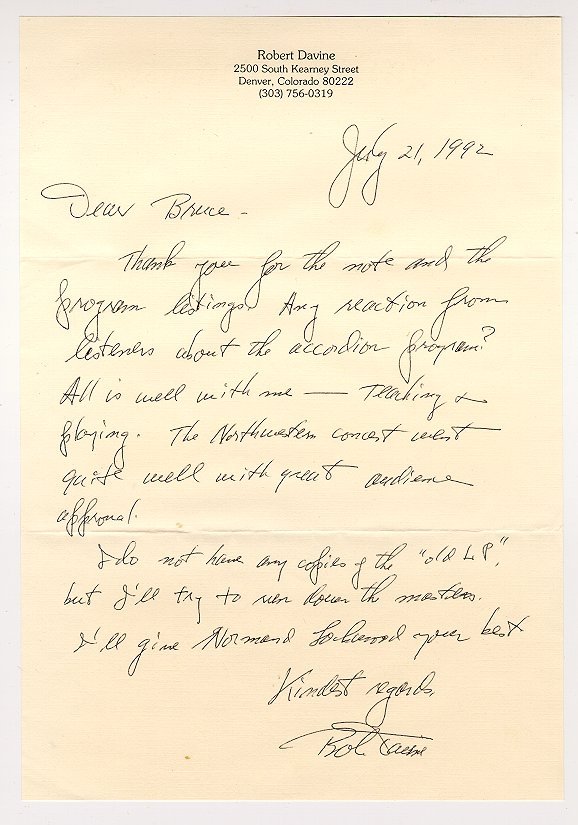
This interview was recorded in Chicago on April 27,
1992. Portions were used (along with recordings) on WNIB in
1992, 1994 and 1999. This transcription was made and posted on
this
website in 2008.
To see a full list (with links) of interviews which have been transcribed and posted on this website, click here.
Award - winning broadcaster Bruce Duffie was with WNIB, Classical 97 in Chicago from 1975 until its final moment as a classical station in February of 2001. His interviews have also appeared in various magazines and journals since 1980, and he now continues his broadcast series on WNUR-FM, as well as on Contemporary Classical Internet Radio.
You are invited to visit his website for more information about his work, including selected transcripts of other interviews, plus a full list of his guests. He would also like to call your attention to the photos and information about his grandfather, who was a pioneer in the automotive field more than a century ago. You may also send him E-Mail with comments, questions and suggestions.